Image
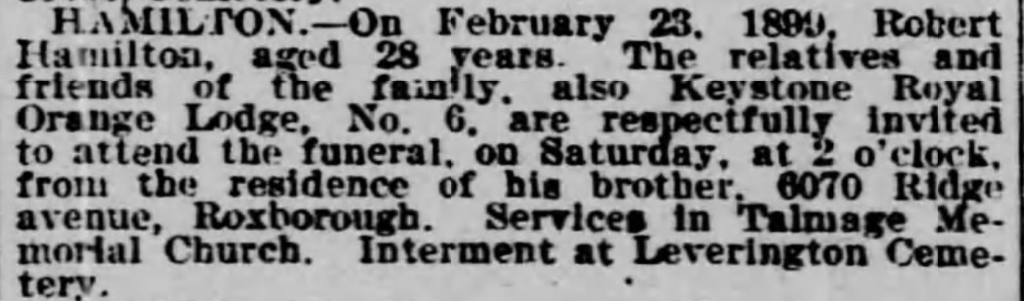
The Hamilton family: life and loss in a turn-of-the-twentieth-century Philadelphia rowhouse.
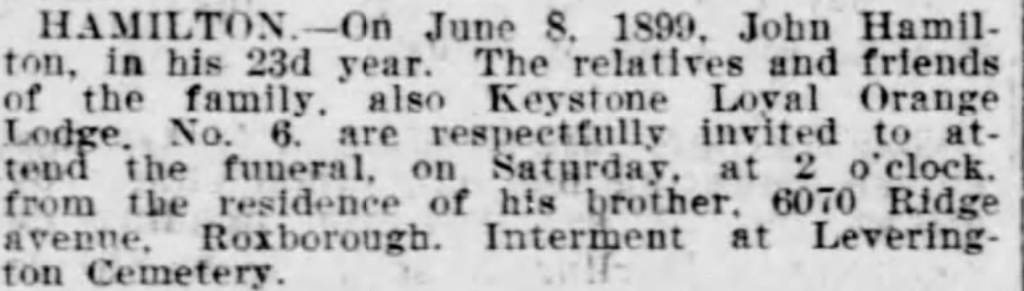
At the turn of the twentieth century in a tenement apartment in Philadelphia, tragedy struck for an Ulster-American family. On the 25th of February 1899, The Philadelphia Inquirer recorded the death of 28-year-old Robert Hamilton two days earlier. Three and a half months later the newspaper recorded the death of his younger brother, John, aged 23 years old. Both men were members of Keystone Loyal Orange Lodge, No. 6 and were waked at their brother James’crowded home on Ridge Avenue in Roxborough.
Using existing fragmentary sources such as newspapers, birth certificates, shipping records and church papers to understand the family’s experiences, the Hamiltons provide a window into Ulster-American life in late-nineteenth and early twentieth-century America. Born in 1873 and 1876 respectively, both Robert and John’s births were registered by their father in Newry, County Armagh. They were part of a large Presbyterian family born to James, a weaver, and his wife Jane, and lived in the heart of Ulster’s ‘linen triangle.’ Over time, nine of the siblings would make their way across the Atlantic as part of a family chain migration. When their mother died, their father joined a few of the youngest as they emigrated to Philadelphia on the Waesland from Liverpool. In America, the family would face further loss with the deaths of Robert and John, but they also established new lives in a rapidly industrialising city.
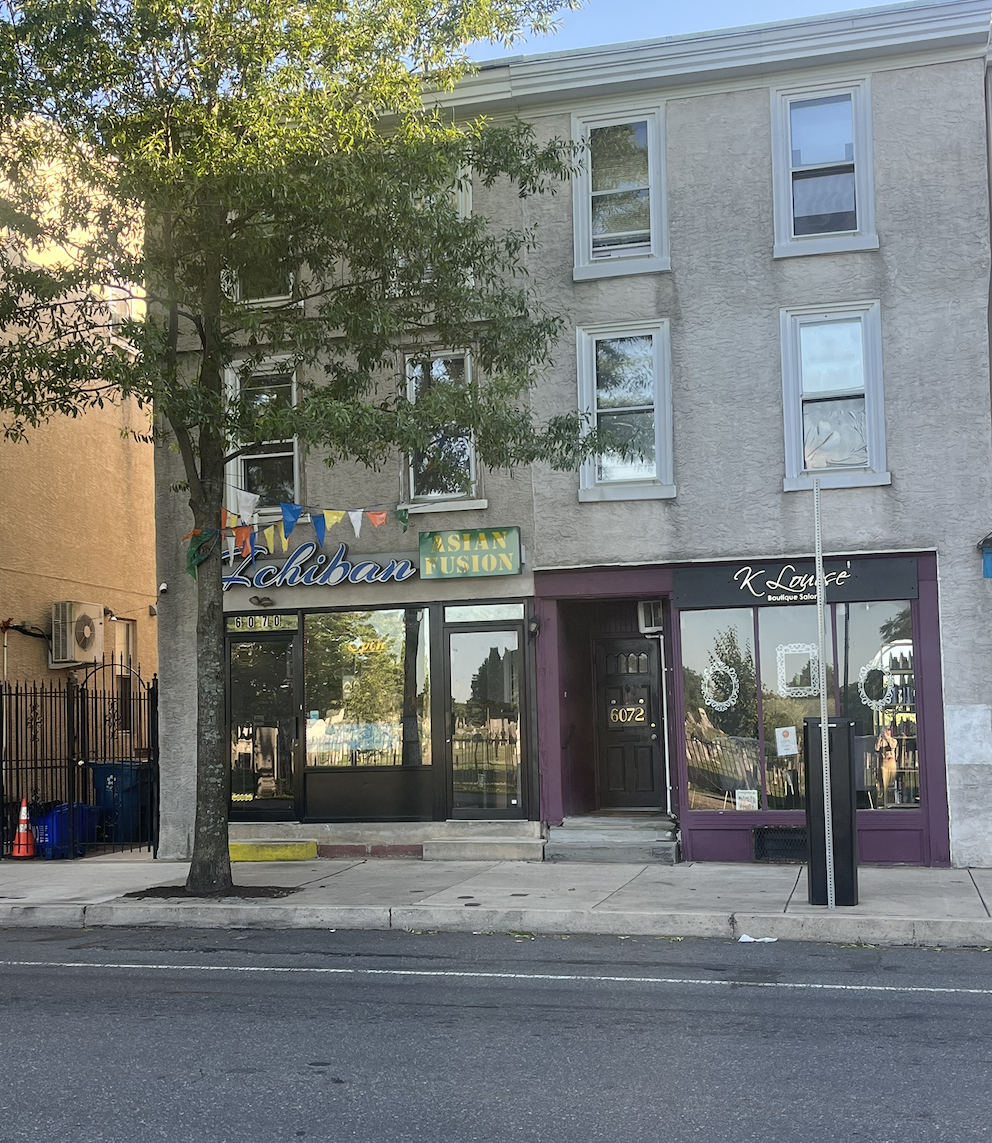
In the year after his two brothers' deaths, James Hamilton Jr. was still living at 6070 Ridge Avenue. The 1900 census shows that there were nine people in the household, including his Ulster-born wife Sarah Price, their two children, four of his siblings and his father. Such crowded, multi-generational households were typical of immigrant life, with multiple wage earners contributing to the household economy. While James Jr. worked as a semi-skilled shoe dealer, his siblings Francis, Martha and Isabella were listed as ‘cloth weavers’, and their youngest brother David was a skilled blacksmith.

Philadelphia was an important textile hub and an especially attractive destination for Ulster immigrants. For families like the Hamiltons, it offered employment that aligned with skills brought from home. Their experience reflects how traditional Ulster industries, such as linen weaving, could be reshaped within an urban, industrial context. Migration, however, was not only economic. It also involved the continuation of religious and associational life.

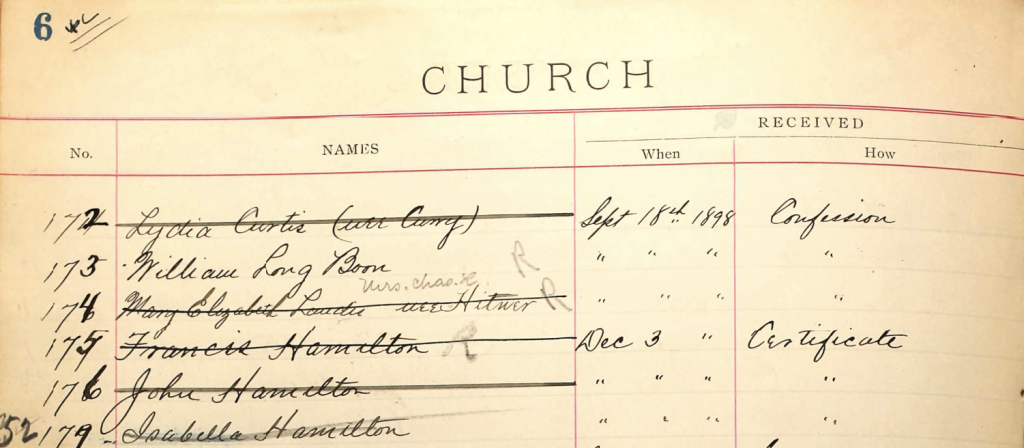
Just months after arriving in America with their father in 1898, John, Isabella and Francis joined the Fourth Reformed Presbyterian Church. Additionally, from their obituaries, it is clear that Robert and John were members of the American Loyal Orange Order, and that their grieving family valued the support of the organisation and its members in their time of need.
The Hamiltons’ story reflects a wider but often overlooked history. Popular narratives of the Ulster migration have focused on early generations of the ‘Scotch-Irish’ settlers on the rural frontier and their contribution to American liberty and independence is celebrated.
Families like the Hamiltons reveal another side of the Ulster-American experience. Later generations of Ulster migrants settled in cities like Philadelphia and New York, where they worked in factories and lived in crowded housing. They brought with them skills, beliefs and identities from Ulster and built new lives in the city shaped by industrial labour, family networks, urban adaptation, and shared religious and associational traditions from home.
In the approach to the 250th anniversary of the signing of the American Declaration, stories of Ulster families in the tenements of the industrialising American North are left untold. My project aims to bring to life these often undiscovered stories of Ulster-Americans like the Hamiltons who navigated life, work, community and loss as immigrants in an urban setting over the period 1840-1910. My work considers a broad sample of both Catholic and Protestant families, exploring urban immigrant family life beyond just the nuclear household. My project considers how identity was maintained and reshaped over a multi-generational period, and how gender shaped domestic life and material culture. It also places these families in the tenements and rowhouses of New York and Philadelphia, where their everyday life brought them into contact with different ethnic and other immigrant groups, highlighting the diverse and vibrant experience of Ulster-Americans in the nineteenth-century American city.