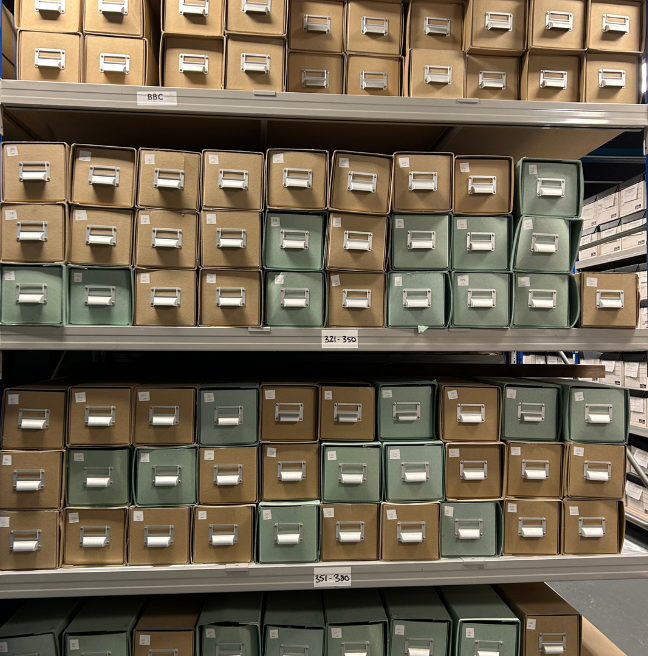
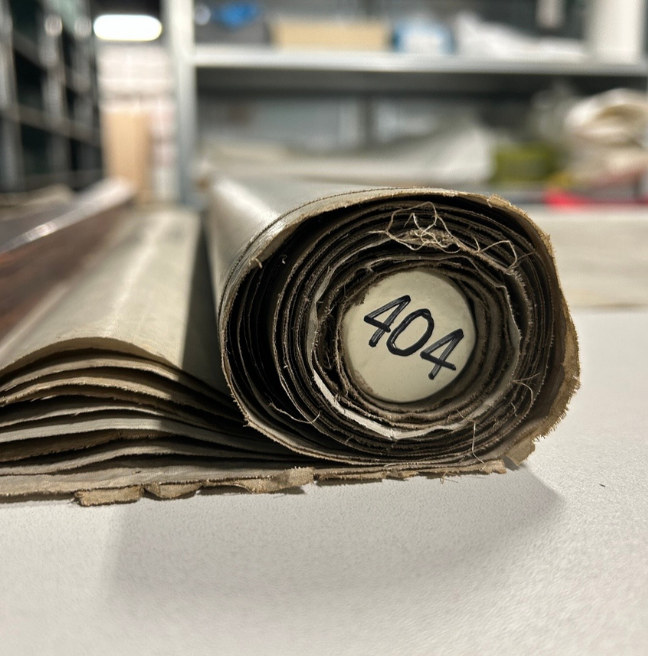
A major project has begun to catalogue the Harland & Wolff Ship Plans Archive at National Museums NI.
Renowned for its marine engineering, technical innovation and world-class craftmanship, Harland & Wolff once had the biggest shipyard in the world. This archive spans over a century of design, with general arrangements, midship sections and rigging plans for more than 1,200 of Harland & Wolff’s 1742 ships.
From Drawing Board to Slipway
Thanks to funding from the Archives Revealed grant programme, we are unlocking the potential of this vast repository of maritime history. Archives Revealed is a funding partnership between the National Lottery Heritage Fund, the Pilgrim Trust, the Wolfson Foundation and The National Archives.
This project will make the archive more accessible to a wider audience, increasing awareness and appreciation of the scale and complexity of vessels built by this iconic Belfast company. Through cataloguing of the ship plans, digitisation and engagement, the archive will reveal its secrets to researchers, historians and anyone interested in the Harland & Wolff story.
The Harland & Wolff Ship Plans Archive is now housed in the Cultra Collections Store, located at the Ulster Folk Museum.
Frequently Asked Questions
Acquisition Journey
The H&W Ship Plans Archive was donated to National Museums NI over several decades. Due to the scale of the archive, the large format of the plans and limited resources, the museum has only been able to facilitate access to academics and researchers until now.
| 1983 | First acquisition of part of the H&W Archive, largely ship plans. A retired marine engineer Percy Reid, and Chris Lundy, a PhD engineering student, began the process of cataloguing the rolled ship plans, which were stored on site in the H&W Time Offices. |
| 1987 | The H&W Photographic collection, comprising around 75,000 glass plate negatives was donated. Covering the 1890s to the 1980s, the collection includes a significant number of images taken by Robert Welch. |
| 2001 | The collection moved to a warehouse on Queens Island, fitted out with storage racking, with other material stored in boxes and tea chests. The Oakbank warehouse was difficult to access for both staff and the public. |
| 2002 | Further donations were made to the collection, which now numbered several hundred thousand rolled and folded ship plans, folders, ledgers and notebooks. |
| 2012 | A large digitisation project of the Olympic-class liners was undertaken, digitising several hundred very large-scale and fragile plans for Olympic, Titanic and Britannic. The retired H&W naval architect David Livingstone assisted with the digitisation project. |
| 2013 | A final large donation was made to the H&W Archive of plans and documents that had been stored in the former H&W Drawing Offices and Headquarters Building. |
| 2019 | National Museums NI began to move the entire collection, estimated at around 500,000 items, to the Cultra Collections Store. NMNI’s paper conservators worked closely with former H&W employees including Tom McCluskie to assess and unpack the collection into its new storage facility. |
| 2026 | National Museums NI is awarded an Archives Revealed grant to unlock this important archive to the public. A project Archivist, Siobhan McLaughlin, is appointed and takes up post. |